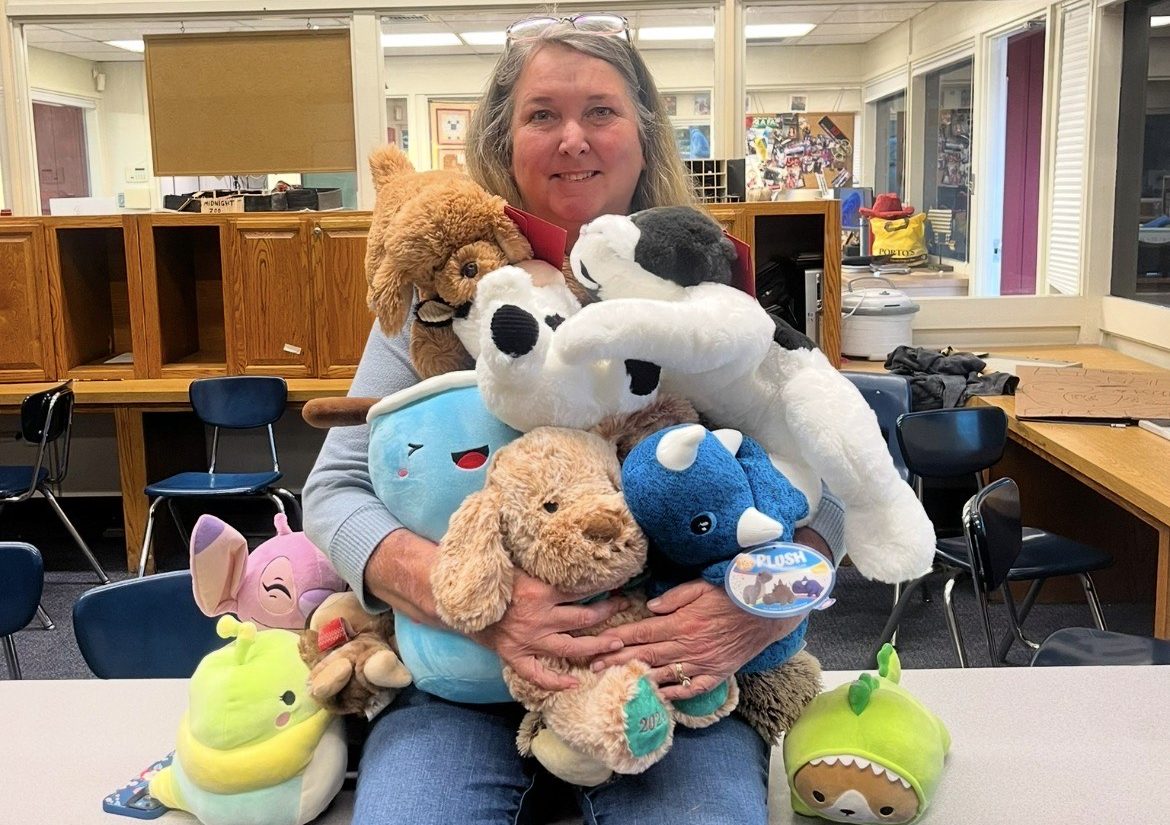
When Kimberley Harris was a sophomore in high school, she didn’t know she was a good writer until her English teacher told her, “Hey, this persuasive essay you wrote is really good. I want you to sign up for my journalism class next year.” So, she did. Over 40 years later, Harris is now the one encouraging talented students from her own English classes to take journalism.
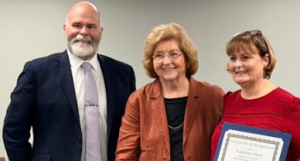
“If my teacher hadn’t pushed me to try journalism, my entire life would be different,” said Harris, who was named Fullerton High School’s 2025-2026 Certificated Employee of the Year. “I certainly wouldn’t be an English and journalism teacher if my teacher hadn’t motivated me.”
Reagan Glidewell, former Tribe Tribune editor, says her path into journalism was quite similar. Glidewell was in Harris’s English class when she joined the journalism class second semester her sophomore year.
“Harris’s strong confidence in me definitely is what made me pursue journalism,” said Glidewell, a 2024 alum who is now majoring in Communications with a concentration in Journalism at Biola University. “Mrs. Harris was always really adamant about saying that I had a talent, and that I had something to offer.”
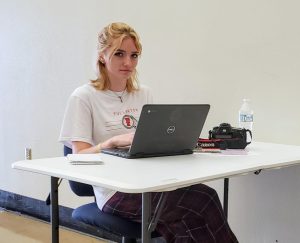
In just two years, Glidewell has been promoted through her college’s media publications, working for the campus magazine then as the managing producer for Biola’s award-winning podcast. She is scheduled to be the editor-in-chief of the school’s digital newspaper in the fall.
Glidewell credits her success to Harris teaching her journalism fundamentals, but she says that Harris teaching her journalistic bravery was even more important.
“I wrote a column about my experiences with grief sophomore year, and I was very vulnerable in that article. I shared a lot of things and I was afraid people would see me differently. But Harris reminded me that journalists have a duty to share good stories, and to make sure that important stories are not viewed as taboo,” said Glidewell, who also noted that Harris teaching her the art of asking meaningful follow-up questions during interviews made her a successful podcast producer.
Harris attended Redondo Union High School where she was editor of the student newspaper and played catcher for the varsity softball team. She attended Cal State Fullerton, 1987-1991, to study journalism but chose to major in English to qualify for CSUF’s teaching credential program.
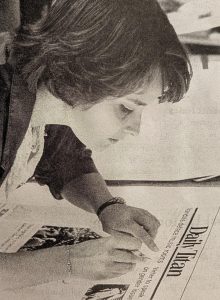
Harris worked on the CSUF newspaper The Daily Titan for three years, but worked in production rather than in the newsroom.
“I was the production manager in charge of sizing photos, formatting text and literally gluing the stories to paste-up boards with hot wax. This was just before college and professional newspapers switched to full pagination, formatting the layout directly on the computer,” said Harris, who had one of only a few paid positions on staff. “The advertising manager and I both earned monthly salaries. I had to pay rent, so I couldn’t afford to work for free as a reporter or editor. The best perk, though, was getting a staff pass and being able to park in the Cal State Fullerton faculty area.”
She was hired to teach journalism and English at Sunny Hills in 1993, when former superintendent George Giokaris was still the SHHS principal. When she was interviewed in Summer 1993, four former Sunny Hills students were scheduled to go on trial for murder.
“Dr. Giokaris asked me, ‘If we hire you, will you allow your journalism students to cover the murder trial?’ I said, ‘Yes, of course. Ed. Code 48907 requires that I allow them to report on important stories as long as they follow professional standards.”
Harris got the job, replacing Carol Hallenbeck, who taught at SHHS 1969-1993.
“Sunny Hills had the best journalism program in Orange County when Mrs. Hallenbeck retired. Teachers with, like, 15 years of teaching journalism applied for the position. It surprised a lot of people, including me, when I was hired the same week as my 24th birthday,” said Harris, who led her SHHS students to several Los Angeles Times awards and became president of the Orange County Journalism Education Association.
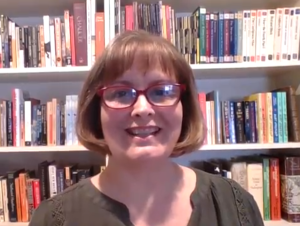
Harris taught at Sunny Hills until 2001 when she decided to stay home with her new-born son. She returned to teaching in 2004 when she taught AP Literature, journalism and co-coached an award-winning Academic Decathlon team at La Habra High School. She transferred to Fullerton in 2011. “The drive from my house in Garden Grove to La Habra was killing me,” she said. “I love teaching at Fullerton and the commute is much better.”
Since her arrival at Fullerton, Harris has found ways to serve all students, not just those in her classes. In January, she created a new tutoring program called Math Mentors that matches math students who could benefit from extra help with NHS students who need community service opportunities. She worked closely with math teachers Blanca Villalobos and Cwynnci Lobaugh to organize materials and match up students with mentors.
Fellow English teacher Nicole Smith admires Harris for being proactive. “Harris just has the idea and does it. Instead of thinking, ‘Oh, someone should,’ she just goes, ‘Oh, I should.’ And then she does,” Smith said.
Smith says that Harris is a good mentor and even convinced her to keep Kafka’s The Metamorphosis on the English 2 Honors reading list the first year they both taught the class. Smith said she was skeptical because she remembered hating the novella when she read it her senior year of high school.
“Mrs. Harris was like, ‘No, no, it’s so good. We do this literary lenses activity with it. I promise. Just give me a little bit of time. You’ll like it. Just wait till you see what I do with it.’ And I have to tell you, I only understand that novella because of Mrs. Harris, because of the way that she came up with this plan for how to teach it,” Smith said.
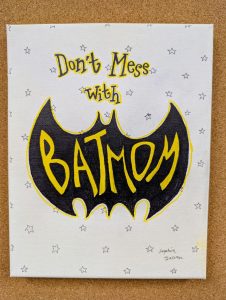
Harris has also collaborated with biology teachers to create English 1 essay prompts and worked with former AP European History instructor Mike Muhovich.
“Mrs. Harris was incredible at supporting me and my students, and she was always particularly looking for what she could do to help out the students in my class and help me specifically,” Muhovich said.
Harris supported his class by connecting the literature she taught to the Renaissance, Enlightenment and other areas relevant to European history.
“Students made connections to John Locke, to Freud and others in her class,” Muhovich said. “AP Euro isn’t just history. It’s intellectual and cultural, and she helped reinforce those ideas.”
Muhovich said the biggest support was when she assigned an AP European History DBQ prompt in her class. While the history class must keep up a rapid pace to cover all content before the AP exam, Harris was able to slow down and teach every element of paraphrasing and introducing sources needed in a DBQ response.
“Now you have an English teacher giving you insights on writing,” he said. “It was a significant opportunity for practice, and having practice with an English teacher is probably even better than having practice in a history class, because time is always our enemy and we are very limited on time.”
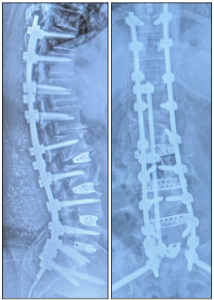
Harris has been on a leave of absence for 10 weeks after having a 10-vertebrae surgery March 25. She was born with a crooked spine that curved too far to the right (from the frontal view) and curved entirely the wrong direction (from the side view). After watching her condition worsen the last few years, her doctor decided to realign her spine with three rods and 20 screws while stabilizing the bottom four vertebrae with “cages” and a spinal fusion.
She says the recovery process is going well. She was able to attend the May 12 school board meeting where she walked without a cane to accept her FUHS Teacher of the Year award.
Harris’s students have missed her fourth quarter, noting that small things make a big difference in her English class. She posts all assignments, deadlines, lecture notes, instructions and essay feedback on the same document every day.
“It’s nice when you’re absent,” said freshman Daisy Lynch. “You can always see everything that everybody did, and what she wants you to do exactly, so you don’t have to go and send an awkward email or anything.”
Harris is a believer in providing models. “Before I assign an essay, I write the essay. Then I write a second essay to use as an example,” Harris said. “I never ask my students to complete a task that I haven’t completed myself.”
Freshman Stella Braun says students like the atmosphere of Harris’s class. “She lets us do a lot of our work independently, and even lets us choose our table partners, so during discussions we are more comfortable talking with each other,” Braun said.
Perhaps most impressive is Harris’s ability to modify assignments to meet the needs of all her students.
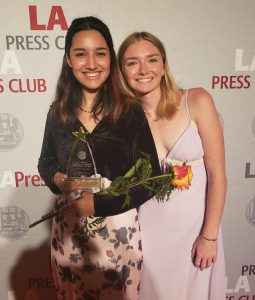
“She knows that some people are stronger writers, and some people need a little more help,” Braun said. “She knows everybody in her class and exactly what they need,” said Braun, who pointed out that advanced students are encouraged to write 800 words instead of 500 words if they need a challenge.
This ability to really know her students goes beyond academics.
Kitty Martinez, who was enrolled in FUHS journalism for four years, said Harris was her biggest supporter.
“I remember I was sitting on the floor in the hall just crying, then I came inside and as soon as I made eye contact with Harris I just started bawling. So she brought out my friend and just left us alone for 20 minutes. And no one else cared that way for me, she was just a stable figure for all my life in high school,” Martinez said.
“That’s one thing about Mrs. Harris, she really just treats you like a human,” Martinez said.