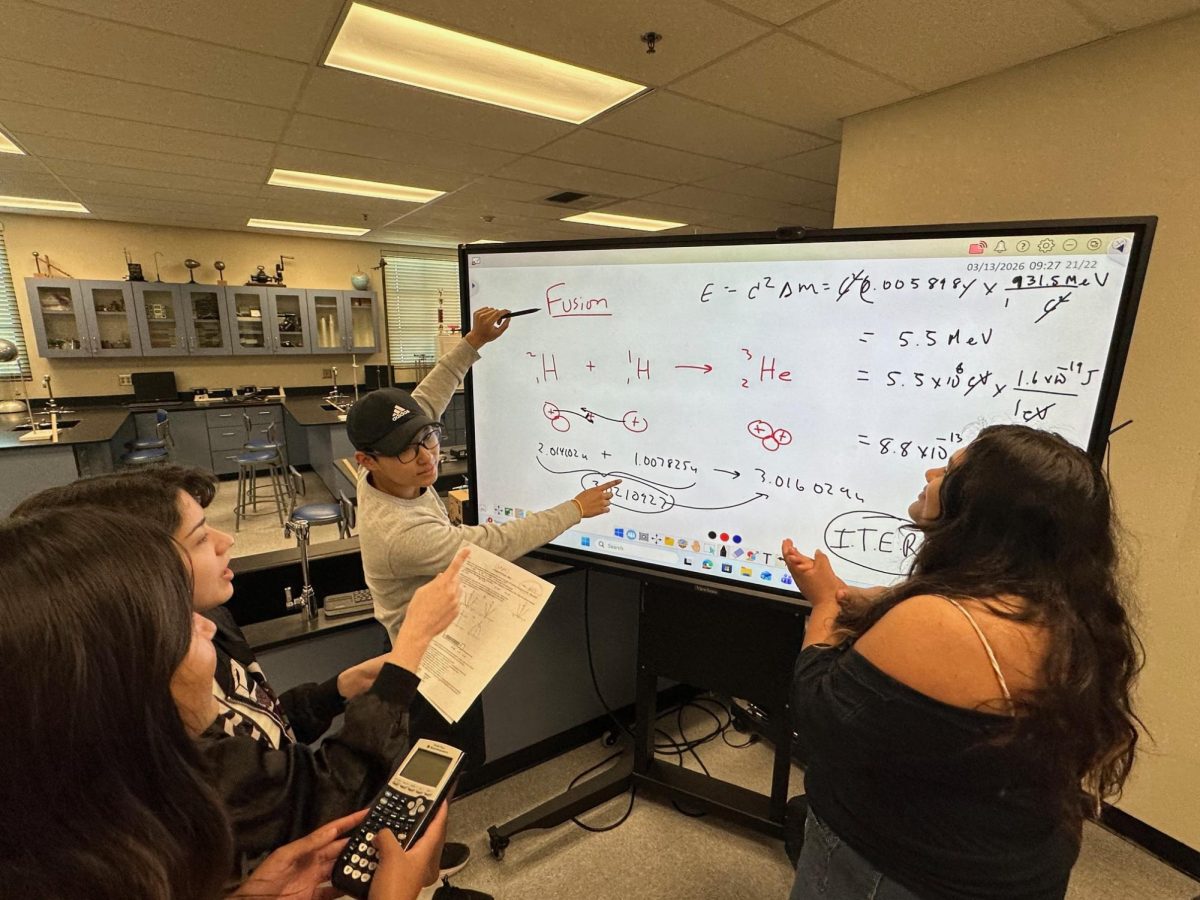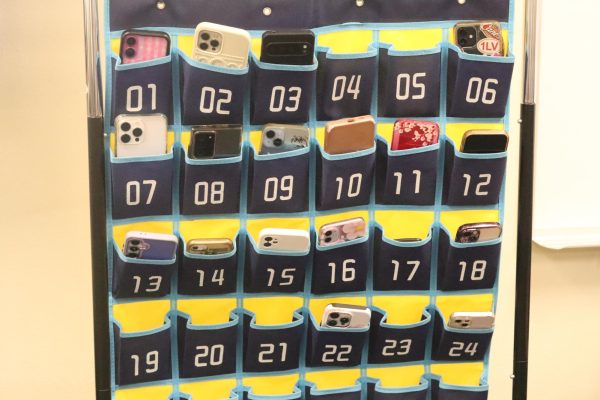
In the past, school officials largely left cell phone policies up to teachers. Some instructors would insist all devices be held hostage in snug phone pockets during class while others encouraged cell phone use for frequent Kahoot! review sessions.
Sophomore Patrick Hong admits that he took advantage of the unclear policy last year. As a freshman, Hong says his ears were constantly plugged into tunes. “My Spotify Status is 50% lower this year due to the cell phone policy,” he said.
Sophomore Nataly Garcia confessed that last year she would find herself looking at random videos on her phone during class, including watching someone make bake-less lemon bars. “Nara Smith was trending and she likes making everything homemade. She would make homemade napkins, too. I don’t know why that interested me a lot,” Garcia said.
So it came as a bit of a shock for some students when they found it necessary to adjust to the new cell phone policy at the beginning of the school year. No longer can they sneak in a few videos or songs during class.
The FUHS cell phone policy had been in place for a long time. However, teachers were free to determine their own classroom policies.
Then, Governor Gavin Newsom signed the Phone-Free School Act last year, requiring California school districts to implement some sort of policy limiting cell phone use in class by July 2026. While FUHS already technically had a policy, the new law prompted administrators to address the teachers’ concerns, according to assistant principal Leticia Gonzalez.
“A lot of teachers were requesting a unified approach,” Gonzalez said. “So this year, coming down from the state of California and now to the district, it made perfect sense to just say, okay, cell phones away during class time.”
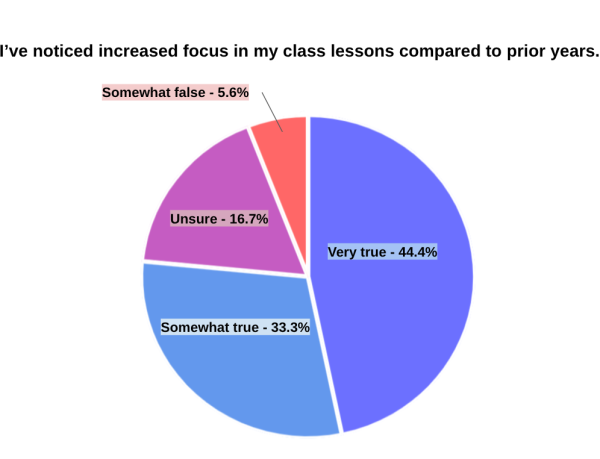
The Tribe Tribune surveyed 583 students and 36 teachers. Teachers reported positive effects coming from the cell phone policy. 75% said it was “very true” that the cell phone policy benefited students’ learning. The majority said it was either “very true” or “somewhat true” that there has been increased focus and productivity in class this year.
“A cohesive, campus-wide policy seems to help students know what to expect and adhere to the policy,” one teacher commented on the survey. Another commented, “I am so glad to have a school wide cell phone policy again! So much better for classroom culture and student learning!”
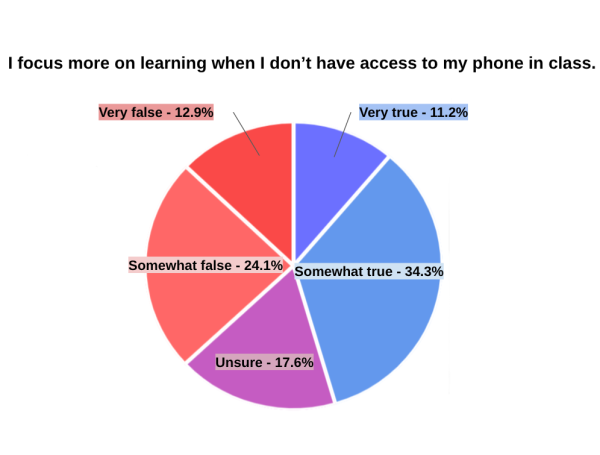
Reactions among students in a similar anonymous survey are more mixed, with a relatively even split on if the cell phone policy increases focus and productivity in class. Several students criticized the policy, saying it’s too strict, that music from their phone helps them focus, or that they don’t believe the policy is that effective.
“My learning ability doesn’t change with or without my phone,” one student commented.
Sophomore Lia Kim said that even if the school sees phones as a distraction, the phones are really useful for students.
“Students probably nowadays use their phones, but I don’t use my phone. I only use it to use the calculator, along with trying to gain extra notes like during homework time in class. I sometimes charge my Chromebook so I don’t have access to do my assignments usually, so then I would just pull out my phone and then just take notes on it through there.”
A lot of students also had concerns about not being permitted to access their phones to contact family during an emergency, but in such an event educators are legally required to allow phone use.
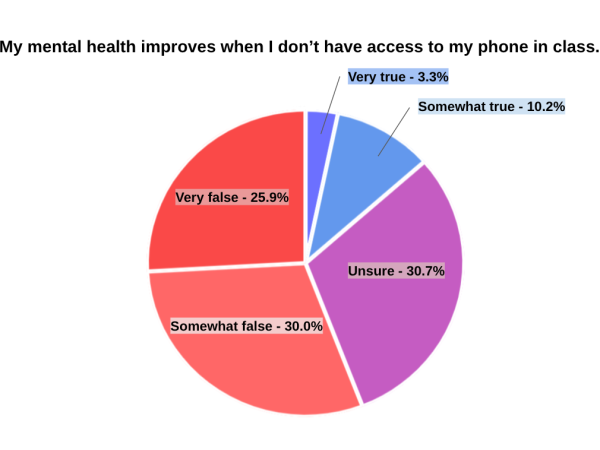
One of the main arguments in favor of the Phone-Free School Act was that less cell phone use would improve teen mental health. However, despite many studies indicating that cell phones have a negative impact on mental health, the majority of FUHS student respondents said that their mental health didn’t improve when they are denied cell phone access.
FUHS nurse Kristina Smith says she’s not surprised that students deny the negative effect the phone has on mental health. Smith says people have gotten used to the stimulation that phones provide and taking them away feels disappointing.
“There’s an addictive piece to it,” Smith said. “There are definitely some studies out there that talk about that endorphin rush that we get from being happy about looking at pictures and the videos and things, and then you take it away and there’s no more rush.”
This contributes to a lack of focus in classes as well.
“There was a time before cell phones where actually people enjoyed learning new information. But now we’d rather [consume media] than attend school, because that’s not as entertaining, stimulating to my brain in a positive way, as rote learning,” Smith said. “A majority of the class hasn’t been able to comprehend what the teacher is teaching, well, because they’ve been distracted. They always used to talk about the idea that multitasking, there kind of isn’t. Our brain really doesn’t do that very well.”
Smith also addressed other ways that cell phone use can impact students, such as sleep deprivation, where parents may think that their children go to bed at a reasonable time but they’re up until late hours on their phone, and vision deterioration.
“You don’t even realize how you’re looking at things, when your eye is exercising as muscles. Focus, unfocused, focus, unfocused, focus, unfocused,” Smith said. “I’m getting more kids with problems with that type of thing, weak eye muscles.”
Responses to the Phone-Free School Act vary by district. In LAUSD’s version, phones, earbuds, and watches must be turned off and stored away; campuses may use pouches, lockboxes, or backpacks.
Across the U.S., 30+ states have passed or are considering school cell phone restrictions. While banning cell phones receives a lot of support, the effectiveness of those policies are being questioned. Public health policy researchers Nirmita Panchal and Sasha Ziter published a research paper last year admitting that measuring cell phone policy effectiveness in improving mental health is difficult.
“Emerging research on student outcomes [of cellphone bans] is mixed, with some studies suggesting improvements in student mental health and academic performance and a reduction in bullying, and others showing little to no change,” their paper said.
However, there are more certain links that tie excessive cell phone usage with poor mental health. Social media use tends to lead to mental health issues, cyberbullying is prevalent, and cell phone use distracts from in-person socializing.
Smith believes that the best thing to do is prevent overuse of cell phones from an early age. However, since high schools can’t do anything about young children, policies like this are the best they can do. “They’re doing what they can given what they can,” Smith said.