What started as a difficult search for interested students turned into a historic finish as six Fullerton Union High School juniors placed ninth out of 388 teams nationwide, securing a spot in the StellarXplorers National Space Design Competition finals hosted this week in Denver, Colorado.
The competition challenges students to design satellite systems and solve complex engineering scenarios using the physics-based software, “Systems Tool Kit” (STK). Participants calculate satellite orbit paths, fuel requirements, and power usage in teams of up to six students under time and cost constraints.
“You not only have to adjust the simulation to see how the satellite moves, but you also have to calculate information about it,” said Merritt Lee, the team’s captain. “For example, if you want the satellite to stay up for a certain number of years, you might need more fuel for it to stay up, or you might need to consider how much power the satellite is drawing, and therefore the battery capacity and solar panel size.”
Lee introduced the program to FUHS after transferring from Troy High School, where he previously competed. As a new student, however, finding enough students to build a team proved difficult.
“I initially pitched the idea to the Aerospace & Engineering Club, but they didn’t really seem interested,” Lee said. “So I asked Mr. P [Team director Jim Pitochelli], ‘Who are some students that seem like they’re passionate about physics and aerospace?’ Then he put together a list of a few people.”
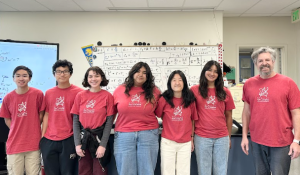
Lee eventually recruited five other juniors from Pitochelli’s AP Physics 1 class: Alexis Hernandez, Katelyn Rodriguez, Molly Kim, James Ha, and Abby Guevara.
“I basically told them that if they were passionate about physics, they should try the first few practices,” Lee said. “And if they didn’t like it, they could always drop it.”
All five students decided to stay.
Since Fullerton High School is a Title I school, they could enter without paying the standard $200 team registration fee. With nothing to lose, the six juniors entered the competition and began preparing for the online qualifying rounds.
“The simulations themselves can be a little confusing and sometimes complicated,” Kim said. “But it just takes a lot of trial and error to find the best solution for each problem.”
Success in the competition depends heavily on critical thinking and analysis. In one trial, the group must determine the most productive way to send a satellite into orbit; in another, they need to calculate the cost and fuel required for a rocket launch.
“It’s more about problem-solving than just physics. You’re trying to find the most cost-effective and efficient model for sending something into space,” Kim said.
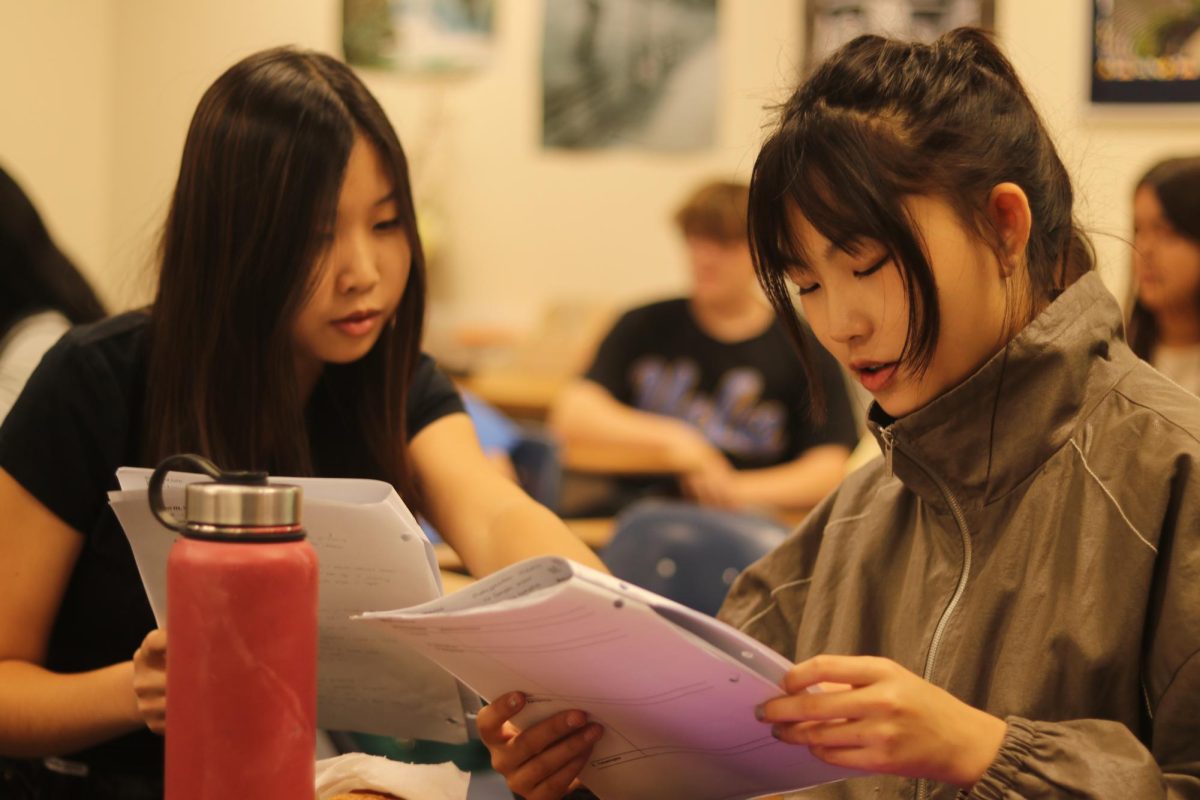
As the rounds progressed, the team began dividing responsibilities. During the semifinals, they split into two groups of three to complete different sections, with Lee overseeing one part and Hernandez leading the other.
While Lee had prior experience, this was Hernandez’s first year in the program.
“The competition was something I’ve never done before, and I wasn’t really familiar with the software in the first place,” Hernandez said. “It was scary taking on a leading role since we trusted Merritt to help us until now, mostly.”
Her group was tasked with designing a rocket to deploy satellites, but as time ran out, they discovered a major error in their calculations.
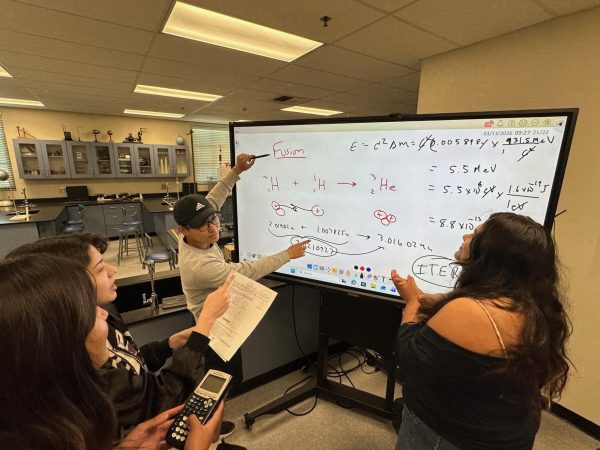
“Near the end, when we were checking each other’s work and mistakes, we ran into a big problem,” she said. “We miscalculated the mass, so we had to redo most of our work with only an hour left of the round.”
Pitochelli said that moments like these highlighted the team’s ability to work together under pressure.
“They were all worried about the error, but I saw how well they communicated and supported each other throughout the round,” he said. “It was amazing to watch, I couldn’t believe it.”
Their efforts finally paid off with Hernandez’s group earning a perfect score, helping the team place ninth nationally and securing a spot in the finals.
“We joined the team just for the fun of it since we had nothing to lose,” Hernandez said. “I even remember Merritt warning us not to have any high expectations. Since our score seemed low, we all thought, ‘Oh, we probably didn’t make it,’ but when I saw the notification that we qualified, I was so excited.”
The unexpected success made the moment feel surreal for the entire team.
“Alexis came into our physics class and told us we made it,” Guevara said. “I was just thinking, ‘That’s crazy.”
The group will travel to Denver, Colorado, from April 22-24, to compete in the final round of the competition.
“It’s a little stressful because we have to travel right before AP exams,” Rodriguez said. “But we’re excited.”
Regardless of the outcome, Pitochelli said the program has already been valuable for the students.
“I was just hoping they would have a rewarding experience working as a team, having fun, and enjoying the spirit of competition,” Pitochelli said. “Now I want to get a second team for next school year to have some competition against these guys.”
The StellarXplorers program is open to all Fullerton students. To learn more or join a team for next season, reach out to Jim Pitochelli in Room 241 or Merritt Lee.