When most students see a ripped shirt with loose threads, they see trash. But what Andromeda Bruschke sees is an opportunity.
As president of the Alliance for Sustainability club, Bruschke’s goal is to promote sustainable practices in our community, starting on FUHS’ campus.
“We’ve been trying to find ways to integrate sustainable practices into what we do on campus and promoting outside events that are related to sustainability as well,” Bruschke said.
And on Dec. 11, AFS will be hosting a “Sew It Don’t Throw It” workshop in room 10, where students bring in tarnished clothes and sew them back together. No sewing experience is needed, as AFS will teach you everything you need to know.
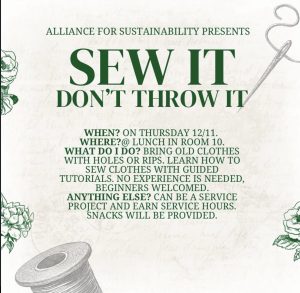
“Anyone’s welcome to come. It’s supposed to just promote sustainable practices and fixing up clothing rather than throwing it away,” Bruschke said.
AFS has also participated in eco fairs, joined in beach cleanups, hosted campus clean-ups, gone on hikes, recycled old paper into new blank sheets of paper, and helped garden Oak Commons.
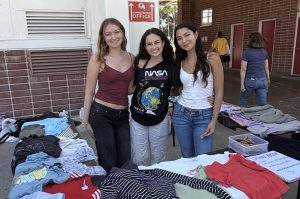
But one of their most successful events are their clothing swaps. During lunch, students bring pieces from their wardrobe and exchange them for different apparel, refreshing their wardrobe without the pollution of overconsumption. Afterwards, the club donates the remaining clothes.
Vice president Sydney Cruz said her passion for the environment comes from her upbringing.
“My family, we’re nature people. Every year we go up to Big Sur and we camp. I just want to preserve places like that, so that everyone can enjoy them,” Cruz said.
Bruschke and Cruz both emphasize that even if students are new to concepts of sustainability, getting involved is the best first step.
“Even though you’re just in high school, you can still make an impact on your community,” Cruz said.
AFS has also taken part in The Sustainable Campus Challenge, which is supported by the Orange County Power Authority.
This educational opportunity involves students coming together and finding ways to create sustainable solutions to solve real-world environmental problems on campus.
Bruschke explained that the process officially began with a Zoom meeting about the program.
“We met with the OCPA, and they went over the modules and the new process,” said Brushke, “It was actually a really cool educational opportunity, and they have a lot of resources–more than we were anticipating.”
The OCPA Sustainable Campus Challenge includes several modules. The first three AFS are focusing on are waste, water use, and transportation. AFS began their project on Nov. 19, 2025. They must complete a detailed assessment of the FUHS campus based on these modules according to staff and student responses. Bruschke described this work as very hands-on.
“So we do surveys and assess our campus in terms of all these issues, and then we submit them to the Orange County Power Authorities by end of January, and then from there, we get to talk with one of their mentors who will help us come up with a plan to reduce or to help make one of those areas more sustainable on our campus,“ Bruschke said.
Part of the assessment includes looking at how accessible public transportation is, how much energy the school uses, how safe it is to bike, and how recycling around campus actually works.
“We have a list of survey questions, and it says things like: ask about electricity use and see if you can find out how much energy we get from solar panels, or talk to staff members about how recycling works on campus,” Bruschke said.
Beyond surveys, the club will also begin gathering concrete data from administration–such as electricity bills, water usage reports, and recycling statistics–to compare them with sustainability benchmarks recommended by the challenge. Bruschke explained that they were also told there might be funding opportunities later in the process, depending on the strength of their project and the solutions they propose. While nothing is guaranteed, the possibility of securing funds motivates the club to ensure their research is accurate.
Although the project is still in early stages, the club plans to begin preliminary research soon and hopes to complete their assessments by January. From there, the group will begin forming concrete goals–whether reducing waste in classrooms, improving recycling systems, lowering energy consumption, or proposing safer and more efficient transportation options.