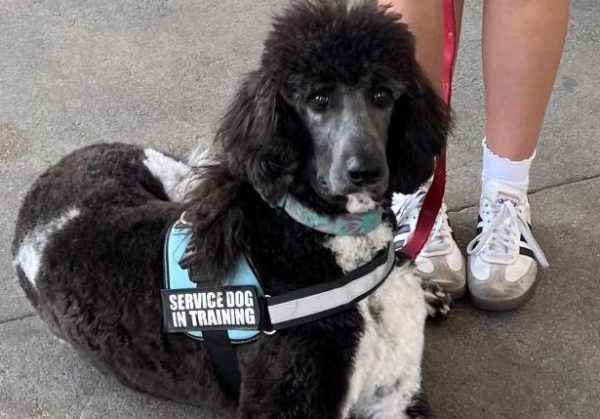
School district officials have told sophomore Jalyce Northgrave that her service dog-in-training cannot attend classes with her at Fullerton Union High School.
Northgrave has been working with Griswold, a Service Dog in Training (SDiT) Standard Poodle, for 10 months so the dog can assist a disabled teenager attend high school.
Hoping to convince the school board to overturn the district’s decision, Northgrave, one of the few teen trainers in the program, plans to plead her case at the Feb. 10 Fullerton Joint Union High School board meeting. If she cannot take SDiT Griswold to Fullerton classes, the dog will be placed with an adult rather than with a teenager.
“The reason I wanted to become a trainer was especially to help teenagers be able to live independently without feeling like they had to have, like, five people with them at all times,” Northgrave said. “There are people my age who need a service dog and I was the person most likely to train one for them.”
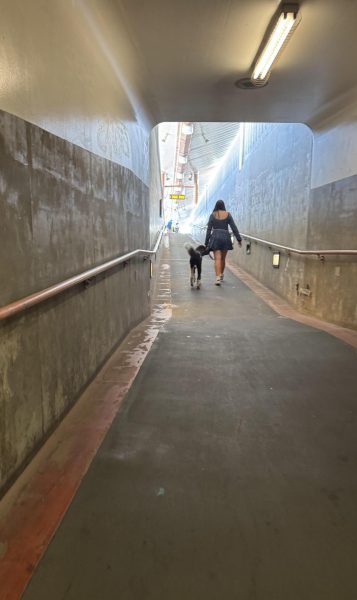
Northgrave and SDiT Griswold are part of the MobilityDog program. Much like guide dogs who assist the visually impaired, the program’s dogs provide support for those with mobility challenges, including people with progressive diseases and spinal injuries.
According to Chenin Northgrave, Jalyce’s mother, these dogs often help people take back their lives.
“Most of the people had something happen in their life where they became physically disabled, like a car accident or multiple sclerosis,” Chenin said. “So it’s life-changing for them if they want to go back to college or want to go back to work.”
Janie Heinrich, MobilityDog’s CEO and City of Pasadena Accessibility and Disability Commissioner, says that preventing Griswold from coming onto campus during school hours violates the California Civil Code and California Penal Code, which state that a trainer or handler may take a leashed and labeled service dog-in-training anywhere that service dogs can go for the purpose of training.
Heinrich said that Christopher Davis, the Director of Human Resources and Risk Management, told her that Fullerton High School is not a place “to which the general public is invited” (as the law says) and therefore is not a public space, which makes it inaccessible for service dogs and service dogs-in-training teams.
Heinrich says that she was told during a Jan. 26 meeting that the district’s legal counsel requires that MobilityDog provide the names of districts that have permitted service dogs in training on their campuses as well as contact information for the trainers themselves. However, she argues that the burden of proof does not fall on MobilityDog to release or share confidential HIPAA-coded information regarding their service dog-in-training or service dog teams.
District officials did not respond to multiple requests for comment from the Tribe Tribune.
Heinrich says there have been about a dozen Los Angeles County high school students in the last six years who have taken their service dogs in training (SDiT) to school with them.
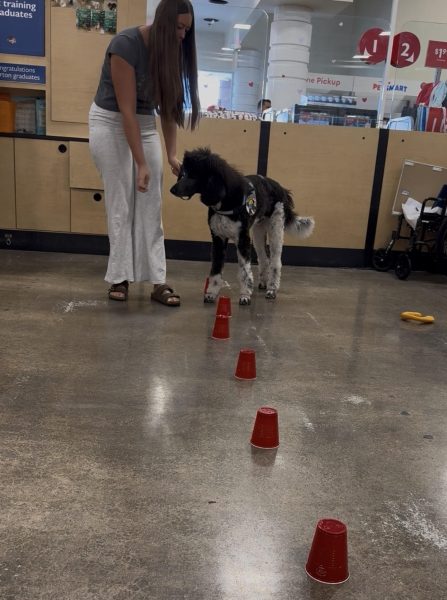
“This demand is not supported by California Disability or federal law and improperly shifts the district’s independent legal obligation onto a private party,” Heinrich said. “All we are asking for is the equal rights and access already guaranteed under California disability law and Title II of the Americans with Disabilities Act.”
The meeting with Davis only happened after several months of delays. Jalyce asked permission to bring Griswold to school 10 months ago (March 2025). While the school itself was supportive, the district denied her request in June 2025 when she asked for an appeal. Since then, the Northgraves and MobilityDog have been asking for an update about the review process with little communication in return.
“We want to move forward with a strong voice and be supportive, but it’s difficult when you’re met with complete ghosting,” Heinrich said.
The Northgraves and MobilityDog have been invited to fill out the standard public comment card for the Feb. 10 school board meeting. However, the school board is not permitted to discuss or vote on an action regarding public comments which are usually given about two minutes at the end of the meeting. The board has no obligation to take action on anything said in public comment.
Instead the Northgraves have been fighting to be included on the meeting’s official agenda to allow for discussion, questions and potentially a vote. A place on the agenda also would allow them to present a 200-signature petition advocating for Griswold’s training on campus.
“The petition is a way for voices to be heard and for people to see that there are a lot of people that support this,” Heinrich said. “It opens the door for education. It opens the door for understanding. It opens the door for more questions to be asked.”
At one time, service animals in training were allowed on FJUHSD school grounds. Starting in 2015, Future Farmers of America students at Sunny Hills High School worked with Guide Dogs of America to raise future guide dogs. According to Sunny Hills agriculture teacher Brian Kim, the program ended in 2021 due to a lack of interest.
“The GDA program is probably one of the most influential and impactful projects any individual could be a part of,” Kim said. “To help raise a dog that would in the future be an extension of a person in need is profound.”
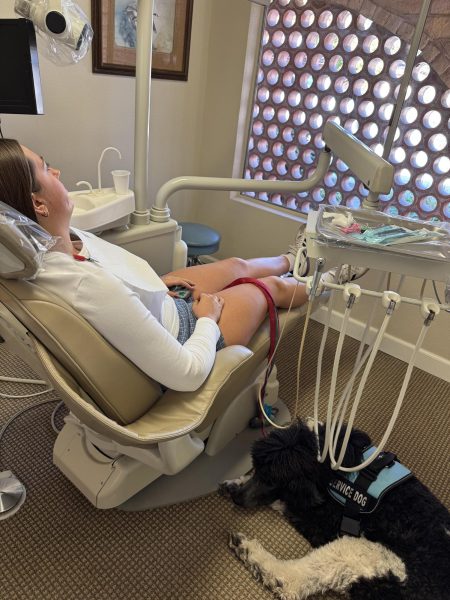
In the meantime, Jalyce is taking SDiT Griswold to other public spaces, and a few school events outside of school hours (such as water polo games). She says he’s well behaved.
“I’ve taken him to the movie theater, and no one knows he’s there until he stands up,” Jalyce said. “And it’s definitely eye-opening for people to see that because a lot of people aren’t used to seeing service dogs around places.”
MobilityDog’s Board of Trustees Member and the Los Angeles County Commission on Disabilities president Carlos Benavides, who’s working with the Northgraves and MobilityDog on this case, emphasizes the importance of service dogs.
“A service animal isn’t a pet. It’s a medical necessity,” Benavides said. “I have one, and that’s because of my range of motion. I have a spinal cord injury, and if I drop something on the floor, I can’t get it. My service dog has to get it for me.”
Jalyce also believes that Griswold could help spread awareness among FUHS students about service dogs.
“A lot of students don’t know what service dogs really are and what they’re for, ‘cause there’s lots of different kinds,” Jalyce said. “If I can bring him, it’ll definitely be an educational thing for everyone, and I think it’s important for other people to see that.”